

Health Library
Umbilical cord care in newborns
Cord - umbilical; Neonatal care - umbilical cord
Images
I Would Like to Learn About:
Information
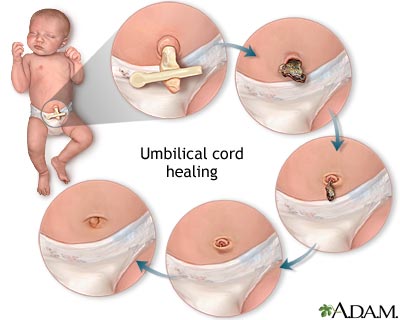
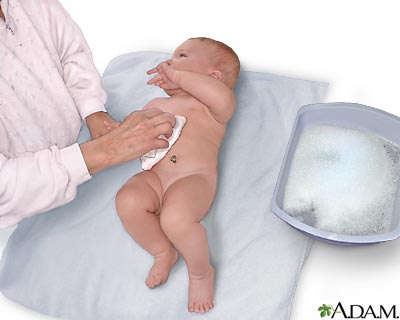
When your baby is born, the umbilical cord is cut and there is a stump left. The stump should dry and fall off by the time your baby is 5 to 15 days old. Keep the stump clean with gauze and water only. Sponge bathe the rest of your baby, as well. Do not put your baby in a tub of water until the stump has fallen off.
Let the stump fall off naturally. Do not try to pull it off, even if it is only hanging on by a thread.
Watch the umbilical cord stump for infection. This does not occur often. But if it does, the infection can spread quickly.
Signs of a local infection at the stump include:
- Foul-smelling, yellow drainage from the stump
- Redness, swelling, or tenderness of the skin around the stump
Be aware of signs of a more serious infection. Contact your baby's health care provider immediately if your baby has:
- Poor feeding
- Fever of 100.4°F (38°C) or higher
- Lethargy
- Floppy, poor muscle tone
If the cord stump is pulled off too soon, it could start actively bleeding, meaning every time you wipe away a drop of blood, another drop appears. If the cord stump continues to bleed, contact your baby's provider immediately.
Sometimes, instead of completely drying, the cord will form pink scar tissue called a granuloma. The granuloma drains a light-yellowish fluid. This will most often go away in about a week. If it does not, contact your baby's provider.
If your baby's stump has not fallen off in 4 weeks (and more likely much sooner), contact your baby's provider. There may be a problem with the baby's anatomy or immune system.
References
Eichenwald EC. The umbilicus. In: Kliegman RM, St. Geme JW, Blum NJ, et al, eds. Nelson Textbook of Pediatrics. 22nd ed. Philadelphia, PA: Elsevier; 2025:chap 144.
Gontasz MM, Keiser AM, Aucott SW. Care of the newborn. In: Gleason CA, Sawyer T, eds. Avery's Diseases of the Newborn. 11th ed. Philadelphia, PA: Elsevier; 2024:chap 16.
Mukherjee D, Ryan RM. Postnatal bacterial infections. In: Martin RJ, Fanaroff AA, eds. Fanaroff and Martin's Neonatal-Perinatal Medicine. 12th ed. Philadelphia, PA: Elsevier; 2025:chap 50.
BACK TO TOPReview Date: 10/7/2025
Reviewed By: Neil K. Kaneshiro, MD, MHA, Clinical Professor of Pediatrics, University of Washington School of Medicine, Seattle, WA. Also reviewed by David C. Dugdale, MD, Medical Director, Brenda Conaway, Editorial Director, and the A.D.A.M. Editorial team.
 | A.D.A.M., Inc. is accredited by URAC, for Health Content Provider (www.urac.org). URAC's accreditation program is an independent audit to verify that A.D.A.M. follows rigorous standards of quality and accountability. A.D.A.M. is among the first to achieve this important distinction for online health information and services. Learn more about A.D.A.M.'s editorial policy, editorial process and privacy policy. A.D.A.M. is also a founding member of Hi-Ethics. This site complies with the HONcode standard for trustworthy health information: verify here. |
The information provided herein should not be used during any medical emergency or for the diagnosis or treatment of any medical condition. A licensed medical professional should be consulted for diagnosis and treatment of any and all medical conditions. Links to other sites are provided for information only -- they do not constitute endorsements of those other sites. No warranty of any kind, either expressed or implied, is made as to the accuracy, reliability, timeliness, or correctness of any translations made by a third-party service of the information provided herein into any other language.
© 1997-
2026 A.D.A.M., a business unit of Ebix, Inc. Any duplication or distribution of the information contained herein is strictly prohibited.
All content on this site including text, images, graphics, audio, video, data, metadata, and compilations is protected by copyright and other intellectual property laws. You may view the content for personal, noncommercial use. Any other use requires prior written consent from Ebix. You may not copy, reproduce, distribute, transmit, display, publish, reverse-engineer, adapt, modify, store beyond ordinary browser caching, index, mine, scrape, or create derivative works from this content. You may not use automated tools to access or extract content, including to create embeddings, vectors, datasets, or indexes for retrieval systems. Use of any content for training, fine-tuning, calibrating, testing, evaluating, or improving AI systems of any kind is prohibited without express written consent. This includes large language models, machine learning models, neural networks, generative systems, retrieval-augmented systems, and any software that ingests content to produce outputs. Any unauthorized use of the content including AI-related use is a violation of our rights and may result in legal action, damages, and statutory penalties to the fullest extent permitted by law. Ebix reserves the right to enforce its rights through legal, technological, and contractual measures.
